


High-Lift Tint vs. Powder Lightener: The Organic Colour Correction Formula Explained
"Tint doesn't lift tint" is one of the oldest rules in hairdressing — and one of the most misunderstood. In the right circumstances, a high-lift tint can be not just a viable lightening option, but the gentler, better choice compared to a powder lightener. Here's the actual science behind when — and why — I choose one over the other during an organic colour correction.
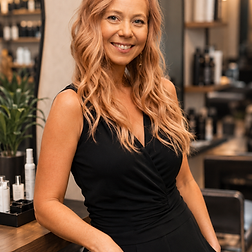
I'm Chantal Haberland, an organic colour specialist in Surry Hills, Sydney. This breakdown is based on a real colour correction service — taking hair from copper red to a natural ash blonde — where both formulas were used strategically, side by side, on the same head.
The Core Difference: Dissolving vs. Swelling
The fundamental difference between these two lightening methods comes down to what they actually do to the pigment molecules in the hair.
Powder lightener works by dissolving pigment — including stubborn natural and artificial red or copper molecules — and permanently removing it from the hair shaft. This is generally the most reliable route to fully neutralising strong, unwanted colour.
High-lift tint doesn't dissolve pigment at all. Instead, it manipulates and swells the existing natural and artificial dye molecules, lightening their appearance while leaving some pigment behind. Because of this, it's a fundamentally gentler process on the hair's structure — and it leaves the cuticle fully intact and able to open and close normally, which supports shine.
When High-Lift Tint Is the Right Choice
High-lift tint can only be used on hair that is either virgin or tinted — and if tinted, the natural pigment underneath needs to still be present. It's not a universal substitute for powder lightener, but where it's applicable, it offers real advantages:
It's gentler on already-compromised or fragile areas, such as the hairline.
It preserves more of the hair's natural cuticle integrity, supporting shine in the final result.
It's ideal for creating a lifted, golden base (often around a level 8) that sets up beautifully for a demi-permanent ash toner afterwards.
In fact, contrary to what many colourists assume, a high-lift tint at 40 volume can behave more gently on fragile areas like the hairline than a powder lightener at 20 volume — because it's only manipulating dye molecules rather than dissolving them.
When Powder Lightener Is the Right Choice
Powder lightener remains essential wherever complete, permanent removal of stubborn pigment — particularly red and copper tones, generally the hardest molecules to shift — is the priority. It's also the right choice for hair that's already been previously lightened, where a gentler formula (often at a lower developer volume) can achieve significant lift without over-processing already-porous hair.
Notably, not all powder lighteners behave the same way. Some gentle, organic formulations are specifically designed to deliver a set amount of lift (often around four levels) and are genuinely ineffective on virgin hair at lower developer volumes — a reminder that "gentle" organic formulas still require the right technical knowledge to use effectively.
Using Both, Strategically, in One Service
The most effective colour corrections often use both formulas — not as a compromise, but as a deliberate strategy matched to each zone of the hair:
Fragile areas (like the hairline): high-lift tint, for a gentler process.
Mid-lengths carrying strong unwanted pigment: high-lift tint or powder lightener, depending on whether full pigment removal or a softer, cuticle-preserving lift is the goal.
Previously lightened, porous ends: a gentle powder lightener at lower developer volume, chosen specifically because it's designed for hair that's already been processed.
Bond-building additives (such as a pure cysteine-based product) can be incorporated into both formulas where hair health is a client priority, further protecting the hair's internal structure throughout the process.
The Bottom Line
Neither high-lift tint nor powder lightener is inherently "better" — they solve different problems. Understanding exactly what each one does at a molecular level is what allows a colourist to build a genuinely tailored, hair-health-conscious colour correction plan, rather than defaulting to one product across an entire head purely out of habit.
If you have hair that's carrying unwanted red, copper, or brassy tones and you're not sure what it will take to correct it, book a consultation with me at my Surry Hills studio in Sydney. I'll assess your hair's specific history and porosity, and build a formula plan designed around it.


Comments