


How to Achieve 100% Grey Coverage With Organic, Low-Tox Hair Colour
If you've ever been told that organic or low-tox hair colour "doesn't cover greys as well" as traditional colour, you're not alone — and you've also been sold half the story.
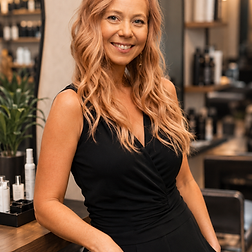
I'm Chantal Haberland, an organic colour specialist based in Surry Hills, Sydney, with over 25 years behind the chair. For a long time, I heard the same rumour every low-tox colourist eventually runs into: that clean, PPD-free hair colour systems simply can't deliver full, long-lasting grey coverage. After years of formulation research and hands-on client work, I can tell you that rumour isn't quite right — it's incomplete.
Why the "Low-Tox Colour Can't Cover Greys" Myth Exists
Most professional low-tox and organic colour brands are built around removing or drastically reducing a small handful of ingredients: ammonia, PPD (paraphenylenediamine), resorcinol, parabens and sodium lauryl sulfate. These are the ingredients most associated with sensitivities and allergic reactions — but they're also the ingredients that have traditionally done a lot of the heavy lifting for grey coverage and colour longevity.
When a brand removes PPD entirely, it's usually replaced with an alternative such as PTD. That substitution is great news for clients with sensitivities, but it can change how the colour performs on resistant, stubborn grey hair — particularly over multiple regrowth cycles.
This is where the confusion comes from. Some low-tox ranges are formulated specifically for highly sensitive clients and are genuinely zero-PPD, zero-resorcinol formulas. Used on every client, regardless of sensitivity, these ranges can under-deliver on grey coverage and longevity. That's not a flaw — it's a mismatch between the product and the client it was designed for.
The Client-Matching Mindset
The breakthrough for me came from working with a brand that offers two ranges side by side: a true "zero" range for highly sensitive clients, and a main organic colour range formulated with very low (but present) trace amounts of PPD and resorcinol — often as low as 0.005% and 0.013% respectively. Those trace amounts are enough to dramatically improve grey coverage and colour longevity, while still keeping the overall formulation low-tox (in this case, around 89% water and roughly 9% functional organic ingredients).
Having both ranges available taught me to ask one simple question before every colour service:
Does this client have a genuine sensitivity to PPD or resorcinol? If yes, the zero/sensitive-safe range is the right call, and it's worth setting expectations that results may be slightly softer or shorter-lasting.
Does this client simply want an organic, low-tox product with strong, long-lasting results and no known sensitivity? If yes, a low-tox range with trace functional ingredients (rather than a full "zero" formula) will usually outperform a zero-PPD system for grey coverage.
This client-matching approach is the real reason low-tox colour gets an undeserved reputation. Brands and colourists who only stock a single, fully PPD-free range — with no alternative for non-sensitive clients — are often the ones fuelling the "organic colour doesn't cover greys" rumour, simply because they don't have a second formulation option to fall back on.
It's Not Just About the Product — Technique Matters Too
Ingredient selection is only half the equation. Even within a single low-tox, PPD-free system, there's a professional technique that dramatically improves grey coverage: a pre-softening step that opens the hair cuticle before colour is applied, allowing far more pigment to penetrate stubborn white and grey hair. I cover this foolproof pre-softening method — the exact steps I use in-salon — in a separate guide, because it's genuinely the difference between "good enough" grey coverage and 100% grey coverage that lasts.
The Takeaway
Organic and low-tox hair colour absolutely can achieve 100% grey coverage — but it requires two things most salons overlook: matching the right formulation to the right client, and using a professional technique to prepare resistant grey hair for colour. When both are in place, there's no reason for a client to ever miss their old traditional colour system.
If you're in Sydney and want to experience organic, low-tox colour that's formulated (and applied) to properly cover grey, book a consultation with me at my Surry Hills studio. I'll talk you through exactly which approach is right for your hair and your sensitivities.


Comments