


Is PPD-Free Hair Colour a Myth? What Every Organic Colour Client Should Know
"PPD-free" is one of the most searched, most misunderstood phrases in hair colour. Clients ask for it assuming it means a completely different chemical process. The truth is more nuanced — and understanding it will help you choose the right organic colour formula for your hair, rather than the one that simply has the best marketing.
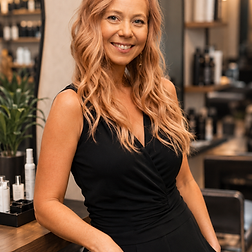
I'm Chantal Haberland, a Sydney-based organic colour specialist with 25+ years of experience, and I've spent a significant amount of time researching exactly what "PPD-free" really means across professional low-tox brands.
What "PPD-Free" Actually Means
PPD (paraphenylenediamine) is a colour developer used in traditional permanent hair dye. It's highly effective at achieving natural-looking tone and, critically, at helping colour molecules bond into the hair shaft for long-lasting results. It's also one of the most common causes of scalp sensitivities and allergic reactions.
When a brand markets a range as "PPD-free," in most cases PPD hasn't simply been removed with nothing to replace it — it's been substituted with an alternative developer, commonly PTD. PTD is generally considered gentler and lower-risk for sensitivities, but it doesn't always replicate PPD's performance, particularly on stubborn, resistant grey hair over multiple colour cycles.
This is an important distinction for clients to understand: "PPD-free" doesn't necessarily mean "free of all developing agents." It usually means a different, alternative agent is doing the job instead.
Why Some "Zero" Ranges Underperform — and Why That's Not a Failure
Many organic and low-tox brands offer a dedicated "zero" range: zero ammonia, zero PPD, zero resorcinol, zero parabens, zero sodium lauryl sulfate. These formulas exist specifically for highly sensitive clients, and they do their job well for that audience — grey coverage is genuinely solid in the short term.
Where these ranges can fall short is longevity. Clients without sensitivities who are moved onto a full zero-PPD, zero-resorcinol range often notice their colour fading faster, and in some cases looking slightly translucent, compared to a formula with trace amounts of these developing agents.
This isn't a sign that low-tox colour "doesn't work." It's a sign that a hyper-sensitive formula is being used on a client who didn't need it — much like using children's paracetamol dosing on an adult. The formula is doing exactly what it was designed to do; it's simply being applied outside its intended use case.
The Trace-Ingredient Approach
The alternative — and the approach I favour for clients without known sensitivities — is a low-tox colour range that isn't 100% zero, but uses extremely small, carefully controlled amounts of PPD and resorcinol alongside a largely water- and organic-ingredient base. In the formulations I work with, this can mean PPD levels as low as 0.005% and resorcinol as low as 0.013%, within a product that's still around 89% water and roughly 9% functional organic ingredients — with ammonia removed entirely and replaced with MEA.
Trace levels like these are enough to noticeably improve grey coverage and colour longevity, while keeping the overall toxic load extremely low. For clients who don't have a genuine PPD or resorcinol allergy, this is usually a far better match than a fully zero formula.
How to Use This Information as a Client (or Colourist)
Before assuming a "PPD-free" or "zero" range is automatically the better or safer option, it's worth asking:
Do I have a diagnosed or suspected sensitivity to PPD or resorcinol? If yes, a genuine zero range is the right choice, understanding that results may be slightly shorter-lasting.
Am I simply looking for a cleaner, lower-toxicity colour option with strong, long-lasting results? If so, a trace-ingredient low-tox formula will typically outperform a fully zero formula for grey coverage.
This is also exactly why so many rumours circulate about organic colour "not working as well" — brands and salons that only offer a single, fully zero-PPD range have no alternative to offer clients who want stronger, longer-lasting results, and those clients' experiences shape the reputation of low-tox colour more broadly.
The Bottom Line
PPD-free isn't a myth — it's a real and valuable option for sensitive clients. But it's also not automatically the best choice for everyone. The right approach is matching the formulation to the individual, not assuming "free from" always means "better for."
If you'd like a colour consultation that actually takes your sensitivities, hair history and longevity expectations into account, book in with me at my Surry Hills studio in Sydney — I'll walk you through exactly which organic formulation is right for you.


Comments